Content
Introduction
Understanding the Salesforce Partner Landscape
What Makes a Boutique Salesforce Partner Different?
How Large Salesforce Partners Operate
Boutique vs. Large: Key Differences at a Glance
When a Boutique Salesforce Consulting Firm Is the Better Fit
When a Large Salesforce Partner Makes More Sense
How to Select the Right Salesforce Partner for Your Business
Introduction
Choosing the right Salesforce partner can make the difference between a Service Cloud implementation that merely works and one that genuinely supports your long-term customer service strategy. For many organisations, the real question is not “Should we use a Salesforce partner?” but “Should we work with a boutique partner or a large consultancy?”
Both options bring clear strengths. The key is understanding how they differ and what that means for your business, your teams, and your customers.
Understanding the Salesforce Partner Landscape
The Salesforce partner ecosystem is broad and diverse, covering everything from strategic consulting to hands-on implementation and ongoing managed services. You’ll typically encounter three main types of partners:
Consulting firms
Provide strategic guidance, process design, and roadmap definition.
Implementation partners
Configure and deploy Salesforce, migrate data, and integrate systems.
Custom solution providers
Build tailored apps, automations, and integrations on top of the Salesforce platform.
Many partners combine all three roles, but their delivery model differs. Some operate as boutique, high-touch teams with a focused portfolio, while others are large, global firms with extensive delivery centres and standardised frameworks.
Fortech Syngenuity sits in an interesting middle ground: an official Salesforce Partner with a certified local team, cross-industry experience, and the nimbleness of a boutique consultancy.
What Makes a Boutique Salesforce Partner Different?
A boutique Salesforce partner typically focuses on specialised areas: specific industries, selected Salesforce clouds, or certain types of projects. This narrower focus allows them to go deep rather than broad.
Typical characteristics of boutique partners include:
▸ Niche expertise
Strong experience in a few selected industries or products, for example Service Cloud, Experience Cloud, or integrations around specific ecosystems.
▸ Agility and responsiveness
Short decision lines, direct access to senior consultants, and the ability to adapt plans quickly when business priorities change.
▸ High-touch collaboration
Close involvement with your internal teams, from discovery workshops to testing and enablement, not just at kickoff and go-live.
For small and mid-sized companies, this often translates into a partner who can match their pace, understand constraints, and adjust the solution in a pragmatic way. For larger organisations, a boutique partner can complement internal CoEs or global vendors with focused expertise on specific workstreams or regions.
At Fortech Syngenuity, this shows in the way we assign certified, stable teams that stay with the client across phases, rather than rotating people out after the initial implementation.
How Large Salesforce Partners Operate
Large Salesforce consulting firms are built for scale. They usually serve global enterprises, run multiple projects in parallel, and rely on standardised frameworks to ensure consistency across regions.
Typical characteristics of large partners include:
▸ Global reach
Presence across multiple countries and time zones, able to support global rollouts and multi-region deployments.
▸ Extensive resourcing
Large teams with a broad mix of skills, from industry-specific consultants to technical architects and offshore delivery centres.
▸ Structured methodologies
Defined delivery frameworks, governance models, and quality assurance processes designed for complex, long-running programmes.
For organisations with multi-national operations, complex legacy landscapes, and large volumes of data, this structure can be an advantage. Large partners are often well-placed to coordinate multi-year transformation programmes across different business units.
However, the same scale can sometimes mean less flexibility in adjusting scope mid-project or tailoring processes beyond pre-defined patterns.
Boutique vs. Large: Key Differences at a Glance
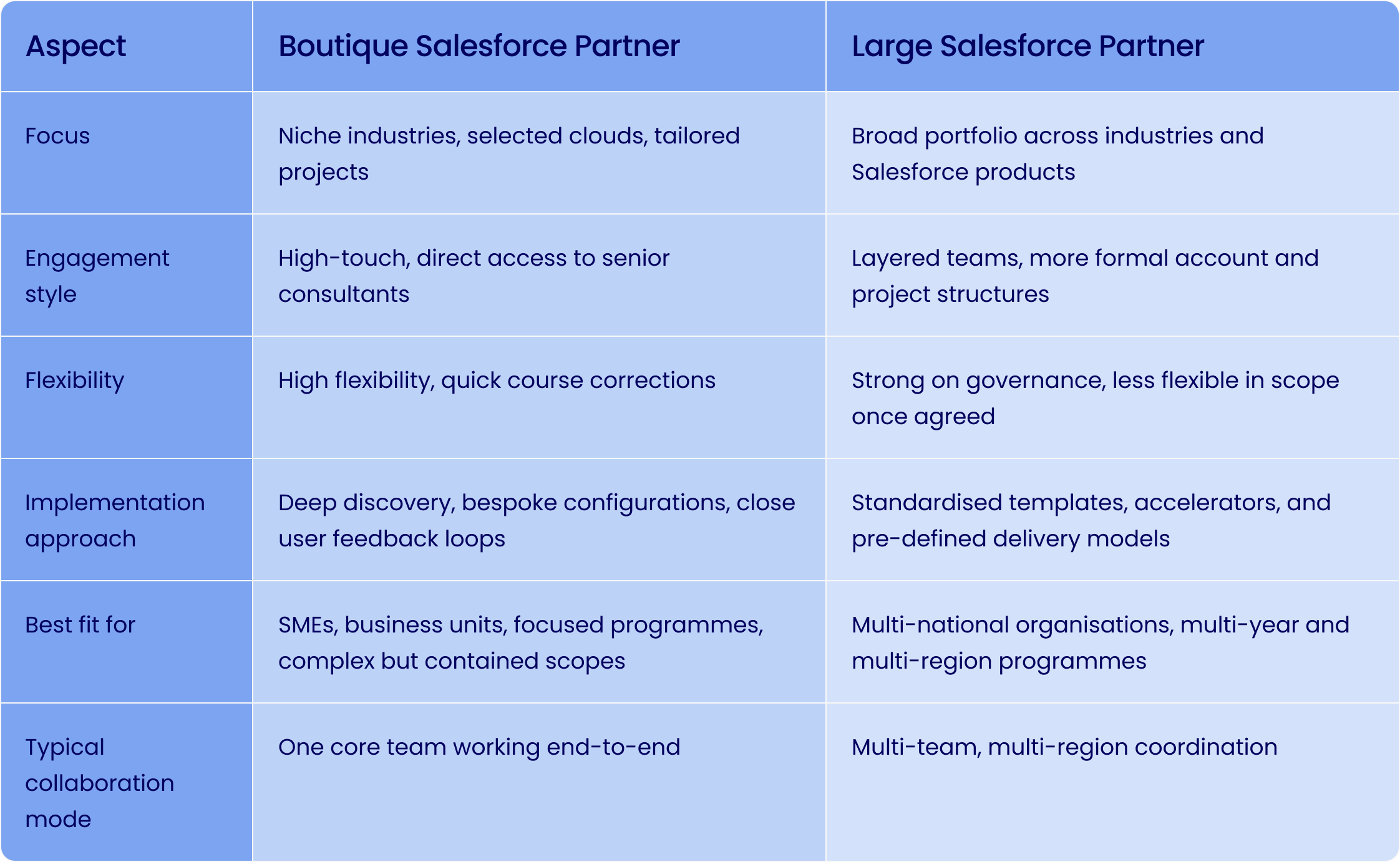
At Fortech Syngenuity, we combine elements from both worlds: we bring the delivery discipline of an established Salesforce consulting firm, while operating with the agility and closeness of a boutique partner.
When a Boutique Salesforce Consulting Firm Is the Better Fit
A boutique Salesforce implementation partner often makes sense when:
- Your business processes are unique enough that “out-of-the-box with minor tweaks” is not realistic.
- You need direct, ongoing access to people who both understand your business and can work hands-on in your Salesforce org.
- You want to iterate quickly, test ideas with real users, and gradually refine Service Cloud or other solutions rather than betting everything on a single big-bang go-live.
This is often the case for:
▸ Fast-growing companies that need to stabilise operations without slowing down growth.
▸ Established mid-sized organisations in niche industries that require non-standard processes.
▸ Large enterprises that want a focused partner for a specific region, product line, or pilot programme.
At Fortech Syngenuity, we work with mid-market clients and enterprise departments that need this balance: structured delivery with enough flexibility to adapt to evolving priorities, regulatory changes, or new service models.
When a Large Salesforce Partner Makes More Sense
A large Salesforce partner can be the better option when:
- You are planning a global rollout across many countries and business units.
- You need extensive change management, training, and localisation work in parallel.
- Your technology stack spans multiple platforms and enterprise systems, and you want a partner already embedded in your global IT governance.
In these cases, a boutique partner can still play a role as a specialist extension of the main programme. For example, optimising Service Cloud for a specific market, building custom integrations, or redesigning flows for a particular service organisation.
Fortech Syngenuity is used to collaborating alongside internal IT teams and larger consultancies, taking clear ownership for specific Service Cloud, Experience Cloud, or integration streams while aligning with the wider programme governance.
How to Select the Right Salesforce Partner for Your Business
Regardless of size, the right Salesforce partner should:
- Understand your industry and business model.
- Have proven experience with similar Service Cloud or cross-cloud projects.
- Be transparent about how they work, who will be on your team, and how decisions are made.
Practical steps to take:
- Start with your priorities
Clarify whether your main challenge is scale, speed, complexity, or the need for tailored processes.
- Review case studies and certifications
Look at projects comparable in size, industry, and complexity, and review the team’s key Salesforce certifications.
- Assess collaboration fit
Meet the people who will actually work with you, not only sales or leadership. Check how they communicate, challenge assumptions, and handle constraints.
- Define engagement boundaries
Be clear where you need a long-term partner, where you only need a project-based engagement, and where internal teams should own the solution.
If you value a partnership approach, where your Salesforce partner immerses in your business and stays involved beyond go-live, a boutique-like firm like us, that can often be a strong match.
Ready To Discuss
Your Salesforce Consultancy Needs?